Using a degraded logo as a security strategy: a false good idea.
Publié le 20/04/2026 10:15
We regularly hear this concern from institutional clients: "By allowing free download, doesn't LogoParc also expose our logos to people with bad intentions?"
The question is legitimate. The answer is no — and we're going to explain why, with the clarity this topic deserves.
Your logo is already circulating. Without you. Without control.
Your logo may already be in the wrong hands. And it's not because of LogoParc.
Before talking about LogoParc, let's establish the real diagnosis.
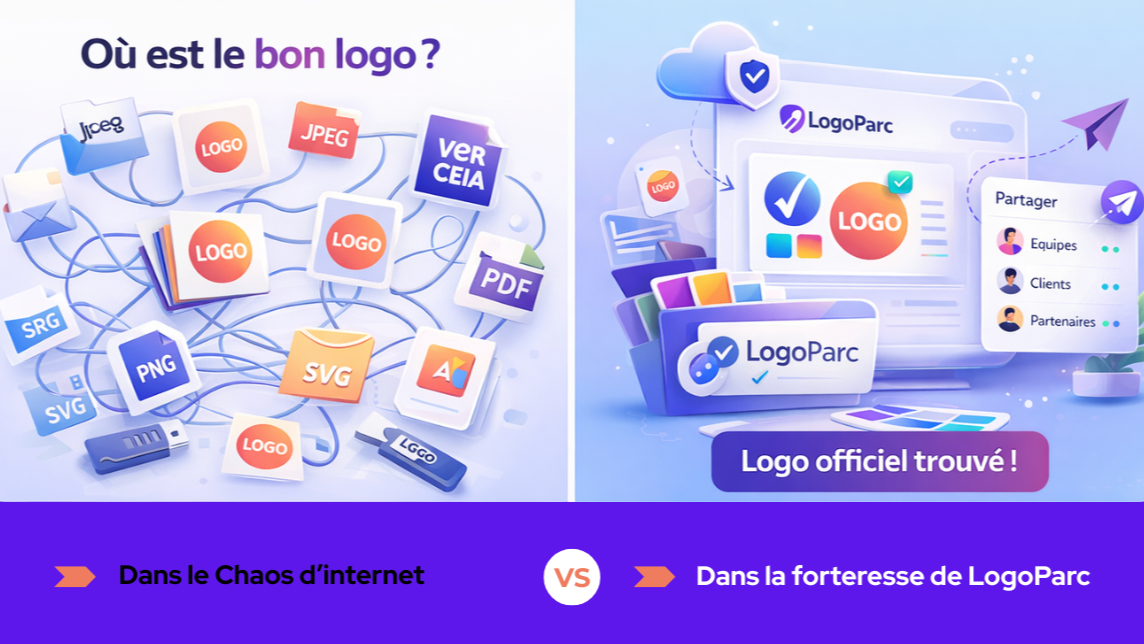
Your logo appears on your website, your press releases, your building facades, your social media. It has been extracted from PowerPoint presentations, copied from Google Images, transferred via WhatsApp, sent by email in low resolution, reused from assets dating back to 2019 or 2021.
It's already circulating — in dozens of versions, across dozens of media, among dozens of vendors you can no longer track.
In the existing disorder, LogoParc creates a single, official, governed source.
In the chaos of the internet, LogoParc is a fortress — a secure sanctuary where your original logo exists at a fixed, stable, official address. A center of gravity that pulls everyone toward the right version, rather than letting the wrong ones proliferate.
Think of your bank.
You could keep your money at home. Some people do. But the vast majority trust their bank — not because they're naive, but because the bank has built itself precisely to secure and manage that asset (money). That's its job. It has infrastructure, tools, and processes you don't have at home.
Governance of logos is our job. We've built high-performance, secure infrastructure dedicated to this — like a central bank for logos.
LogoParc is the central bank for your logos. A cadastral registry of visual identity. The official address, the headquarters, the reference everyone turns to. Not because we impose it — because we have the proper infrastructure to host and manage the original.
A justified concern, but an illusory security strategy
Some institutions adopt what you might call "security through degradation": keeping degraded versions of their logo online, thinking that poor-quality counterfeits will be easier to detect. The reasoning holds up on the surface. It doesn't stand up to analysis.
First blind spot: degradation doesn't target bad actors.
A degraded version circulating doesn't choose its recipient. It reaches indiscriminately — your communications agencies, your printers, your institutional partners, your event vendors — everyone who needs your logo to work with you, and who deserves the best version. Every use of poor quality, even perfectly legitimate, damages your image. Degradation doesn't discriminate: it penalizes everyone.
Second blind spot: official versions already coexist.
Believing that only degraded versions circulate is an illusion. In reality, both coexist. The official versions of your logo are already accessible — on your website, in your annual reports, your press releases, your official materials. A malicious user who is sufficiently motivated will find them. The degradation strategy doesn't block them — it penalizes you, not them.
LogoParc removes dependency and frees your teams.
No more logo requests arriving the day before an event. No more versions pulled from a 2019 presentation. No more follow-ups. The LogoParc link is permanent, and your original logo is always there, compliant, available. No one forwards anything anymore — everyone goes to get the original from the same place, including you.
Every download is an acceptance of responsibility.
LogoParc is not an anonymous platform. Every download is conditional on explicit acceptance of the usage terms you define as the brand owner.
→ The user is identified and committed before they even obtain the file.
→ Any use contrary to the accepted terms engages their responsibility — not ours, not yours.
→ For the first time, you have real traceability on who accesses your official logo.
None of this exists when your logo circulates via WhatsApp, email, or a shared Drive link — which, by the way, opens a security breach into your entire storage space. A poorly managed Drive link exposes far more than a logo.
Because control and accessibility are not opposed
For institutions with the highest requirements, our Premium and Platinum Brand plans include enhanced control mechanisms:
→ A Logo Lock system, requiring every download to be explicitly validated by the brand owner.
→ Distribution Key control, limiting downloads to pre-authorized partners and vendors.
→ Statistical reports, providing visibility into all downloads made.
Where some see a flaw, we see the heart of the solution.
LogoParc was designed to solve a structural problem: your logo is circulating in total disorder, with no traceability, no guaranteed compliance, no single official source. Free download is precisely what draws vendors toward the official source — rather than toward the dozens of uncontrolled alternatives that already exist.
The conclusion is clear.
Sacrificing the quality of your image for 100% of your legitimate contacts in an attempt to slow down potentially 1% of fraudulent uses is a trade-off we cannot recommend. In an era where brand image is a strategic asset in its own right, letting your visual identity circulate in a degraded state is not a prudent measure. It's a calculated risk — one far more certain in its negative effects than the threat it claims to contain.
Your logo deserves real governance. Not a folder in a shared Drive.
LogoParc — The official address for your logo — www.logoparc.com

